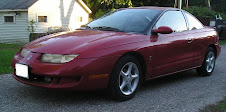
Sunday, February 27, 2011

Vacuum System Repair 2 and Tachometer Progress

Although the vacuum pump doesn't run all the time anymore, I've noticed that it does run more often when it's colder outside.  So I installed a gauge and valve near the pump so that I can isolate the pump from the rest of the system.  Like this:

The pump stayed on until the gauge read ~23 in Hg.  As soon as the pump kicked off the gauge steadily dropped to ~20 in Hg (took about 30 seconds), where the pump again kicked on to bring it up to 23.  Once it reached 23 and the pumped kicked off I shut the valve to isolate the pump from the rest of the system.  The gauge stayed rock steady at 23.  Opening the valve made the gauge dropped immediately.  So, there's something going on in the pump causing the vacuum to leak.  I think the answer is to put a check valve at the pump intake.

Also, some progress on getting the tachometer to work with the DMOC "speedometer" signal.  A search of the EVAlbum showed that there was one other person who used my motor/controller in a Saturn.  Oddly enough, it's another Greg, though he uses the extra g at the end of his name (Gregg Witmer).  Although he hasn't gotten his tach to work to his satisfaction, he sent a schematic of a circuit that he thought would.  Using that schematic as a starting point, a nice EE friend of mine and I succeeded in getting the tach needle on my "spare" instrument cluster to move.  Here it is at 1000 rpm equivalent:

The tachometer is designed to accept 6 high-to-low transitions in the square wave from the PCM for every engine revolution, so 1000 rpm on the tach means 6000 transitions per minute from the PCM, or 100 Hz.  Gregg's circuit actually uses a flip-flop chip to create a square wave from the pulse that the DMOC puts out, so the DMOC will need to put out twice as many pulses.  With our function generator at 1.58 kHz the needle moved up to nearly 8000 rpm, as expected.  Yes!

The tachometer draws more power than we expected, however.  The 1/2 watt resistor we used to pull the signal down to ground was getting mighty warm!  A quick calculation showed that we were actually pulling 250mA through it, which translates to 3 watts.  Oops.  A 5 watt MOSFET worked fine, though.  Next step is to try the circuit with the actual DMOC output to see if it'll drive the tach.  Then convert the breadboard circuit to something that'll be able to live in the car.

Monday, February 14, 2011

Bad vibrations

I have been worried for quite some time about vibrations in my drivetrain.  When I first got the car on the road last fall I was worried about the flywheel balance - even with the car standing still and in neutral, revving up the motor made the whole assembly wobble.  After replacing the clutch and having the flywheel balanced, this test produced very little shaking.  However, the car still shook like crazy while driving, especially at certain motor speeds (seemed to be between 3000 and 3500 rpms).  I mean, I thought the car was going to shake completely apart (not to mention reduce my fillings to dust!).

The other problem I've been having is that the clutch stops working from time to time, especially when it is very cold out.  Not good.  So, this weekend I replaced the clutch hydraulic assembly and reinstalled the original (rubber) transmission mounts.  No pictures, but here's how it went:

To access the top of the transmission I had to remove the accessory battery, vacuum pump, and the "high voltage" electrical box (the box that houses all my shunts for measuring current).  Then I removed the right-hand (driver's side) tray from the engine compartment.  Then I disconnected the slave cylinder from the transmission and the clutch pedal from the master cylinder pusher rod.  In order to pop the assembly off the firewall, I had to disconnect the brake master cylinder from the booster and nudge it away from the wheel well so there was room for the clutch master cylinder to be pulled straight back from the firewall.  Installation was opposite of removal, except for the part where I accidentally popped the top of the reservoir and poured brake fluid all over the splashguard.

Replacing the transmission mounts was pretty easy, though I ended up loosening the left side tray in case the motor came in contact with it when I raised the transmission.  Removed the driver's side front wheel, fender liner, and splashguards.  Removed the solid torque rod from the top of the transmission and chassis frame, removed the nut which attaches the lower transmission mount to the frame and the bolts which attach the mount to the side of the transmission.  Using a floor pump jack, I gently raised the transmission high enough to clear the stud which protrudes through the frame and removed the solid mount.  Installation was the reverse of removal.  Lowered the transmission assembly back onto the frame and installed the nut on the stud sticking down into the frame.  Next I installed the torque rod on the top of the transmission and into the chassis frame.  I had to push back slightly on the transmission to get the bolt to go into the frame (which means that the hard mount on the motor side is probably a tad off center).

After reinstalling the equipment trays and all the components I took my first ride with the rubber mounts.  All I can say is the difference couldn't be greater.  It was so quiet I felt like I was in a cushy Cadillac.  And the clutch was working like a dream.  Oh, the EV grin was back with a vengeance!  I couldn't believe I waited so long to put those rubber mounts in.  The car is a joy to drive now!  There are still a few motor speeds where you can feel vibrations, which I think is related to the fact that the motor is still hard-mounted, but I no longer feel as though the car is about to disintegrate.  I'm back in business!

Wednesday, February 9, 2011

PakTrakr issues fixed

I received the newly-repaired PakTrakr remote from Ken Hall late last week.  Thanks, Ken.  I was able to quickly re-install the remotes to monitor all 13 of my batteries.  In order to avoid the max voltage limitation of each remote, I am now monitoring 5 with the first remote, 5 with the second, and 3 with the third.  As you'll recall from my previous post (1/31/11), during the "high voltage" phase of the charge cycle I was bumping up against this max voltage limitation (86 V, or 2.4 V/cell), causing the remote to misinterpret the voltage of the 6th battery and giving me all kinds of erroneous error messages.  Here's an image of a typical charging cycle:
Notice the voltage for Batt6 and Batt12.  Also, the Pack Voltage is only measured as ~195V, whereas my multimeter showed the expected 218V.

With the new monitoring scheme, I am able to correctly monitor all 13 batteries throughout the entire charging cycle.  Yay!

Now I just have to figure out why the voltage sags so much when the motor controller pulls on them hard.  That'll be another story.

Tuesday, February 1, 2011

Commuting again

Yesterday was a good day.  Any day I can commute gas-free is a good day!  In the morning the outside temperature was 18°F but the batteries were a toasty 70.  Even with the cabin heater drawing power to keep the windshield clear the batteries were fine all the way to work.  Ditto on the way home.  I even drove my son to the high school later in the evening before plugging in.

Of course, between today and tomorrow we're slated to get almost 2 feet of snow.  So I wimped out and drove the dino burner this morning.  The CdV would probably be fine even with a 2 hour commute, but why risk it?

Sunday, January 30, 2011

PakTrakr issues

Another thing that's been nagging at me is the fact that my PakTrakr system fritzes out during part of the charging cycle.  The 6th battery's voltage in each remote drops to 4 volts at the peak charging voltage, so it's forever saying that "Battery 6 is failing."  Manually checking the voltage of that 6th battery showed that it was approximately the same as the other batteries, just over 16 volts.
Looking at the PakTrakr serial logger output, each remote maxxed out at around 86.5 volts.  Six batteries at 16.4ish volts each is just over 98 volts.  If the remote can't detect over 86-87 volts, that would cheat the last battery by around 10 volts.  The reduced readings make sense, then.

According to Ken Hall at KJH Motor Company (maker of the PakTrakr system), the remote is designed to be limited to 90 volts (although mine clearly were limited to 86-87 volts).  That means the remote can only measure the 36 cells (6 12V batteries that have 6 cells each) up to 2.5 V/cell.  AGM and Gel lead acid batteries are charged at up to 2.45 and 2.4 volts respectively, so the remote can (barely) monitor 6 of those types of batteries.  Flooded lead acid batteries are charged up to 2.7 V/cell, beyond the capability of the remote.  Fortunately he also told me that there's no problem monitoring 5 batteries per remote (it will not mess up the display or serial logger).  Since I have 13 batteries I already had 3 remotes, so I'll be able to use a 5-5-3 monitoring scheme and eliminate the out-of-range problem.

Unfortunately, I killed my third remote (the one that was monitoring the 13th battery).  Apparently, one of the unused leads contacted another battery terminal while I was reinstalling it after some battery maintenance that burned out something inside it.  I've sent it back - hopefully it can be repaired...  Until then I'll be limited to monitoring 10 of my batteries.

Vacuum system repair

Last week, having gotten the batteries warm and the receptacle fixed, I started working the batteries up to be able to start commuting again.  Driving around I noticed that the vacuum pump was running a bit more than normal.  By the time I returned the pump was running continuously.

I had wanted to change the vacuum reservoir anyway, because I had to cut away some of the splashguard where the tie rods came through to make room for the reservoir.  This unfortunately allows water to splash into the engine compartment, and I have been worried about the DMOC and some of my other electrical connections.

$5 at a local junkyard got me a new splashguard.  The original reservoir is a 10" length of 4" ABS pipe.  In it's place I constructed a "U" shaped construction of 2" PVC pipe.  This construction has a smaller volume than the original, but I think it'll do the job and the smaller pipe fits nicely between the tray holding the DMOC and water heater and the firewall.
With the new system, the pump takes about half the time it did for the initial draw down.  It comes on more frequently than before, but for less time.  Every indication is that the system is now relatively leak-free.  Once again I appear to be ready to commute again.  It starts tomorrow.

Tuesday, January 25, 2011

Improving the plug

I haven't been totally happy with the receptacle in the fuel filler area of the car.  Because the Saturn's body is plastic there wasn't really much to attach the receptacle to.  Just a single mounting hole where the fuel filler pipe was mounted (above and to the right of the receptacle in this picture).  Because it is only held on with a single bolt it is difficult to fully engage the turn-lock connector.  Sometimes I even had to reach behind the fender liner to hold the receptacle to make the connection.  Not good.
From the back you can see the exposed terminals.  I don't really like that, either.  Especially when I have to reach back there to steady it when making the connection.  It might get splashed, too, so corrosion may be a problem down the road.
So, instead of a receptacle I decided to make a pigtail that could be pulled out when I want to plug it in.
Once it's connected I can stuff the connection back inside the car so the fuel filler door can be almost shut.  Hopefully that'll keep the snow out.
I might consider notching the door so it can be closed completely.  I'll have to wait and see how much water and snow gets inside.

Monday, January 24, 2011

Battery Warmers

With the drivetrain vibration fixed (sort of), the next problem is that the batteries have been so cold that they just won't give me enough juice.  Using a surface thermometer, I measured the temperature at 33 degrees F.  Brr.

I ordered battery warmers from KTA Services, one for each battery.  Farnam Battery Heater Pads, thin mica sheets sandwiching a ribbon heater.  They run on 120V AC, so I wired them so that they will be powered only when the car is charging.  For once, I actually successfully planned ahead when I brought a neutral line into the car in addition to the two hot wires and ground.  In case anyone's interested, here's the wiring diagram for the heaters.  As you can see, I split the power for the heater between the two hot leads of the 220V AC coming into the car.
The worst part about installing the heaters is that the batteries have to come out.  Ugh.  Heavy.  Here are the batteries from the rear box in all their weighty glory.
Here are the heaters laid out in the bottom of the rear battery box.
And with the batteries in place.
In this view you can see the the wiring for the heaters.  I ran the wires along the sides of the box so the batteries can come out without affecting the heater wiring.  And here the batteries are back in place.  Finally.
Here's the control box wiring.
And the box in place in the trunk of the car.
Notice the temperature of the batteries?  The controller on the left is for the rear box, the one on the right for the radiator box.  The outside temperature was about 15 degrees F at the time.  Nice.

Sunday, January 23, 2011

Checking in

Almost 3 months since my last post.  I'd like to say it's because I have been commuting gas- and problem-free for all this time.  Alas, no.  After commuting for a week or two I decided to fix the vibration in the drive train.  So began a series of setbacks and missteps.  Then winter set in.

Here's the sad picture of my engine compartment with everything taken out.
With the motor and transmission separated I measured the runout of the flywheel with a gauge indicator.  Less than .003" range on both the axial and radial directions.  I think most of that runout was just because of the rough surfaces, too.  So the flywheel was installed true.  The only other explanation would be that pressing the starter ring off the flywheel caused it to go out of balance.  So I took it and a new clutch and pressure plate to an automotive machine shop to have them balanced.  Here are a couple of pictures of some of the holes they put in the flywheel to bring it into balance.  The large hole in the first picture (at about 7:00) existed prior.
With the newly planed (notice the shiny front surface!) and balanced flywheel reinstalled on the motor shaft, the dial indicator showed less than .001" runout.

It's now been over a month since I took the car off the road.  It took another 2 weeks to get the car back together and on the road again.  The good news is the vibration in the drivetrain is much better.  There are still a few speeds where the car gets loud, but I think those are related to the fact that I eliminated the rubber mounts and not from imbalance issues.  The bad news is that after a few shifts the clutch stopped working.

The automotive machine shop had wanted to make sure the taperlock hub was balanced as well, so I took the extra effort to get it off.  It was stuck on the motor shaft pretty good, not the least because of some rust on the inner hub surface.  So when I reinstalled it after the flywheel balancing I put a small amount of anti-seize on the motor shaft.  My initial thought about the clutch problem was that perhaps the lubricant had allowed the taperlock hub to be pushed toward the motor by the force of the clutch.  So, out everything came again.

Well, the hub had not moved.  However, it looked like the new pressure plate was taller than the old one by about .12" so I shifted the hub out a bit, thinking that maybe I was at the end of the throw for the clutch.  Put everything back together again.  Same result.  Clutch works for a few times then nothing.  So, maybe the clutch is failing.  Before investing in a new clutch, a friend suggested bleeding the clutch hydraulics - maybe some air got in one of the lines while the slave cylinder was hanging free (I had it tied up near the fuse box to keep it out of the way while removing the motor-transmission).  Took the cap off the clutch cylinder and pumped the clutch pedal 10 times.  Miraculously, the clutch started working again.  Sigh.

By now winter had set in, and this year's winter is the real deal.  Lots of snow and lots of cold.  So even though my drivetrain problems seem to be solved, the cold is really taking a bite out of my batteries.  I am not able to get more than 120 amps out of them before the voltage sags below the cutoff for my DMOC controller.

Next entry: battery warmers....

Monday, November 8, 2010

Back on the EV road

Haven't had an entry in a while.  When last we spoke I was dead in the water because of a broken shifter bushing.  Here's what it looked like when I removed the center console (bits of black plastic under the shifter is what remained of the bushing - the brown ring at the end of the cable coming from the right side of the picture is where it should have been).
I found a replacement bushing on eBay for $17.  It took a few days to arrive, but all of 45 seconds to install.  Here's a picture of the bushing snapped into the cable-end ring.
Here is the cable end with bushing snapped on to the bracket connected to the shifter.
And the view from the other side.
Since replacing the bushing, I've put about 400 miles on the car commuting to and from work.  The shifter feels great.  However, I am still concerned about the vibration coming from the drivetrain, so I am now in the process of taking everything out of the engine compartment so I can get the motor-transmission assembly out for diagnosis.  More on that later.

Friday, October 15, 2010

The excitement after the lull after the excitement

Well, after I said that the tread on the tires wasn't too bad Murphy started making himself known.  Two of the tires started leaking: one because the rim is so corroded, and one through the valve stem.  So I enlisted the help of Tire Rack and in 2 days 4 new wheels showed up at my doorstep, freshly mounted and balanced and ready to go on the car.

Getting insurance was actually more difficult than I expected.  My current insurance agent (AAA through Commerce Insurance) refused to cover it because the conversion was not done by a professional.  I called a few other agencies that other converters have had success with (Progressive, Farmer's, MetLife) to no avail.  Finally, I asked the advice of an acquaintance a few towns from me who is driving a conversion, and he gave me the name of his insurer (Liberty Mutual).  They had no qualms about insuring my conversion, so I switched all my auto insurance business to them.  Not only that, I'm now paying 20% less even after adding this car to my policy!

Once the insurance was squared away, getting plates was a no-brainer.  The insurance agent filled out an RMV1 form for me, specifying that it now has an electric powertrain.  I took that and the Title with the purchase info on the back (from 2009!) and took it to the Registry.  They didn't look at it twice.  Took all of 30 seconds to get my plates (most of that time was filling out the check!) and I was on my way.

Of course, once I went to get it inspected I realized that I should have asked a few more questions because the computer still thought the car was gas powered.  Oddly enough, the technician could change it right there on his computer.  Who knew?

The inspection experience was interesting.  I went to the gas station where we've gotten all of our cars inspected for 10+ years (thinking it might help to have some experience with the guy), and I explained to him that it is now totally electric and that although it is a manual transmission he could treat it as if it were automatic.  That was surprisingly hard for him to understand.  He kept trying to feather the clutch to get the car started!  But he eventually got it into the inspection bay and punched in the license plate number into his computer.  That's when we realized the Registry had not done their job right when the registration was entered.  But once he made the change on the computer the safety part of the inspection went easily enough, and the sticker went on the window in no time.  Of course, by then all of the mechanics were gathered around the car asking questions so I popped the hood and showed them the engine compartment.  I couldn't really tell if they were impressed with my handiwork or just thought I was crazy.  When I pulled out of the station they were all standing at the inspection bay door watching - wondering if it would actually be able to avoid getting hit? - and I waved out the window as I left.  See you next year!! (but not before..... heh, heh)

So here I am at home sucking juice out of the wall.

And at work.

Things were going so well!  Then Murphy again knocked at my door.  I was tooling around town with a friend (he's helping me work out a way to interface the dashboard tachometer with the DMOC motor controller) the evening after my second commute to work (yes!) when the shifter went slack (no!).  Fortunately, it was still in gear but the shifter lost all contact with the transmission.  So I pulled over to the side of the road and quickly determined that the connection between the shifter and the shifter cables were gone.  So I limped home (boy, acceleration is poor when you start out in 3rd gear!) and took the center console apart.  The bushing that held the main shifter cable to the shifter rod was in pieces and scattered about.  Well, at least it wasn't something that I had done wrong during the conversion - I never touched the stupid thing!

Of course the dealer sells the bushing only with the entire cable ($216!), but thank goodness for eBay.  Apparently these bushing fail all the time and there are people who sell machined parts (<$20) to replace the poorly-designed originals.  The only downside is that they have to ship it to me, so I'm spewing fumes to get to work again.  But hopefully not for long.

Friday, October 1, 2010

The lull after the excitement

After those heady days leading up to the Coupe de Volt's maiden voyage, the last few weeks have been a bit of a letdown.  But I trudge forward and am getting things done.  Progress has been made on a number of fronts:

Fixing stuff that's broken: the burnt out headlight and fog light were easy enough to replace, but the backup lights took a little more effort.  I quickly determined that the bulbs were fine and that the problem was in the "back-up light switch" on the transmission.  Fortunately, it was very easy to replace ($15 at Autozone) so I now have working backup lights.  I think the car will pass the safety inspection now (tires are loud but the tread is good so I think they'll be ok, and the alignment isn't that bad).

Battery monitoring: I had previously run 3 wires from the batteries in the front of the car to the rear of the car for the PakTrakr, so the next step is to splice in to those wires to make the connections to the batteries and the PakTrakr remote module.  Each remote monitors six batteries, so I needed 3 remotes to monitor my bank of 13.  The instructions for connecting the batteries to the remotes were straightforward, but it was a little confusing at first as to how to connect the 3 remotes together and to the display.  After a bit of trial and error I finally got it right.  The correct wiring scheme goes like this:
Wire #1 from each remote (to be connected to the negative terminal of the lowest potential battery in the series for that remote) has an in-line fuse soldered to the lug.  So because "Battery #1 is in the front of the car I had to splice that lug/fuse into the wire that I had previously run through the car.  That was really the only tricky part to connecting the PakTrakr wires to the batteries.

Slight modification to the battery box vent: I placed the vent hole in the back of the battery box as high as I could without cutting into the steel frame, but the hole was actually below the top of the batteries!  So I constructed an air dam to draw air from the top of the box.  The air dam consists of a few layers of plywood which are glued together then screwed to the wood.  Here are a couple pictures:

Friday, September 10, 2010

On the road!!!

I had finished the dash gauges and the battery connections on Tuesday, and considered if I should try to run the car or not.  I was a little squeamish about doing the "smoke test" and wondered whether I should push the car outside the garage so it wouldn't take the garage with it when it caught on fire.  But the garage owner convinced me to do it, sooooo....
  1. Connect the accessory battery.  No smoke.  No blown fuses.
  2. Connect the Anderson connector to put the traction battery voltage to the DMOC.  No smoke or sparks.
  3. Turn the key to the "on" position.  The usual warning lights come on then go off except for "service engine soon" (yep, better check that!) and "low fuel" (no gas here!).  The vacuum pump runs for about 8 seconds, then shuts off.  Other than that, nothing.
  4. Put it in neutral.  Press on the accelerator.  Nothing.  No spinning sound.  Bummer.
  5. Hook up the laptop to the DMOC.  Read the ccShell instructions.  1st thing it says to do is load the .ccs file that came with the DMOC.  Oops.  I forgot to bring the file!  Go home with my tail between my legs.
Next day, Wednesday.  I've loaded the .ccs file on the laptop and all I think about all day at work is getting to the car and trying it.  I've also thumbed through the ccShell manual (interface software for the DMOC).  Yeah, I know.  I didn't read the manual before I started - who does?  Anyway, in the manual it says that there are 4 things that have to happen before the DMOC will spin the motor, after the main contactor closes.  Hmm, I never heard the main contactor close last night.  Reading on, I see that the controller comes configured to look for a "Drive Enable" signal before closing the contactor.  I don't remember seeing that signal in my ElectroAutomotive instructions.  Apparently it's a signal that is used when connecting the motor directly to the differential (no transmission).  There are instructions on how to configure the DMOC to bypass the "Drive Enable" signal.  Now I'm antsy to try it.  So I sneak out of work as early as I can and .....
  1. Connect the laptop to the DMOC.
  2. Turn the key on.
  3. Check the "Drive Enable" configuration.  Yep, it's looking for the signal.
  4. Disable the signal, save the parameters.  I hear a nice ka-chunk as the contactor closes.  Yes!
  5. Disconnect the laptop, close the hood, get in the car.
  6. Put it in neutral.  Press on the accelerator.  I hear spinning!
  7. Put it in reverse.  Back out of the garage.  I'm moving!
  8. Put it in forward to drive out toward the road.  Nothing.  I feel a little rocking motion, then the motor kicks out.  Reverse, 1st gear, 2nd gear, doesn't matter.
  9. Put it back in neutral.  Motor spins.  Hmm.  Transmission problem?
  10. It's late and I have to go.  So I get some help and push it back in the garage.  That's a bummer.
Here's the car while I'm trying to go forward.

Later that night I do more reading.  There are a number of variables and parameters that could cause the motor to cut out, related to torque limits, current limits, what have you.  I figure I'd better connect the laptop again and see what the DMOC is saying.  The next day I'm anxious all day.  It's almost as bad as when my wife was expecting - the anticipation is killing me!  As soon as I can, I get over to the car again.
  1. Connect the laptop to the DMOC.  This time I use a longer serial cable so I can run it out of the hood and through the open passenger window so I can keep communicating with the DMOC.
  2. Turn the key on.
  3. ccShell says the last error was #16, PS_FLT_CHARGER_ERROR.  Apparently it's an error related to inadequate grounding or shielding.  Hmm.  It also says that in subsequent revisions of the software this error has been deleted, and can be ignored by setting a variable.
  4. I set the variable to ignore the error.
  5. I get in the car, put it in reverse. Back it out of the garage.  So far so good.
  6. I put it in 1st gear.  Forward motion!
  7. I drive out toward the road.  I slap on plates from my other car.
  8. I drive to a friend's house.  We chat.  I show him the car.  I drive home.  I turn the regen on, then off, then on, noticing how it changes the driveability.  I like it when the ammeter shows negative amps.  Recovering energy - cool!  All in all a 4 mile trip, speeds from 30-45 mph.  Very satisfying.
Here's the car in the driveway after my successful forward motion.
Maiden voyage complete!

So, my take from the experience.
  1. The EV grin is real.  And very satisfying.
  2. Pick-up was not great.  I was able to get up to speed, but it took longer than I liked.  On the other hand, I noticed that I was never pulling more than 150 amps.  The paperwork says that the max current is just under 300 amps, so maybe it comes tuned down at first and the pick-up can be improved?
  3. The car needs some (non-EV) work.  Back-up lights don't work, one of the headlights and fog lights are out, the tires are LOUD, it needs a front-end alignment, and there is some noise/vibration from the drive train (transmission?).

I'm off for a week now, taking my daughter to her first year of college (in IL), so nothing's going to be done for a while.  Next steps: fix the broken things, install the Pak-Trakr (battery monitoring), finish the dash switches (that control the cabin heater and DMOC regen settings), install the battery box lids, and get the car registered!

I'm excited and motivated again!

Catching up - battery connections and dash gauges

I've been neglecting the blog lately (again), but have made progress.  And last night, yes, the car went on the road for the first time!  Very exciting.  Still much to do before it'll pass inspection, though.  More on that later.

Battery connections:
In order to make up the battery cables, I "splurged" and bought an el-cheapo hydraulic crimper from Harbor Freight and went to town.  Following the instructions from the ElectroAutomotive kit, I cut back the insulation on the cable, filled the lug with Noalox, inserted the wire, crimped it, slipped a piece of heat shrink tubing over it, heated it up to shrink it down, and voila.  A completed connection.  Repeat 137 times.  Or so it seemed.

Here are a couple of views with the batteries connected.  The big piece of pink plastic tubing seen in two of the views is 1" heat shrink covering the fusible link for electrical isolation.  The same pink heat shrink is covering the main tie-down for the lower box - during installation that steel tubing has to come very close to terminals!
Next I made the connections to the main shunt and the motor controller.

Dash gauges:
For the 3 gauges supplied with the kit (traction pack current and voltage, accessory battery voltage) I bought a generic 3-gauge pod that mounts on top of the dashboard.  Nothing spectacular here.  I ran the wires up from under the dash and through a couple of small holes drilled in the top of the dash.  For mounting the pod I cut out a small piece of aluminum (.1" thick), drilled and tapped holes to match the mounting holes on the pod, and sandwiched the dash skin between the aluminum and pod.  Very solid.  Here are a couple views of the installation.  Sorry for the dirty windows.

Monday, August 30, 2010

Completing the main battery box

The batteries have been loaded into the main battery box.  Here's how it went.

I previously showed connecting the exhaust vent and fan to the rear of the box and to the back of the trunk.  On the front side of the box I had previously made a cutout for the battery cables to run through.  Using a hodge-podge of electrical and plumbing fixtures and adapters, I cobbled together something which connects the conduit which I had previously installed in the hump and the front of the battery box.  Here's a picture of the hodge-podge in place.
Next I caulked around the edges of the wood pieces inside the box.  I will probably regret this later when I decide to rebuild the box, but I used silicone caulking (white, no less).  Hopefully it won't be too ugly to remove.  Once that was cured I started loading batteries, starting with the batteries in the rearmost positions.  It was a pretty awkward situation, and since the batteries weigh 87 lbs each I could not lift them into the back box.  I considered some elaborate hoist that could levitate the batteries into position, but then snapped out of it and placed a piece of plywood to act as a ramp from the forward lip to the rear of the box.  Worked like a dream.
I had previously designed battery tie-downs to keep them from jumping and sliding around while I'm driving, but I also want to constrain them from the bottom as well.  I bought some rectangular HDPE extrusions (3/8" x 1") to use as guides - I figured I'd screw them in to the bottom wood to give myself a positive stop when positioning the batteries.  Here's a view of the guide at the back of the box.
Here's a view of the "side guide" for the back of the box.  I hung this one from the side because the gap was too narrow to use the full width on the bottom.
Here's a view of guides that are just wedged in between the batteries.  (Not a press fit, just snug)
Here's a view of the front guides in the rear section.
I used the same technique to create guides in the front section as well.  Some screwed into the bottom wood before the batteries are installed, others slid into place after the batteries are loaded.  In this case, the batteries were designed to be snug against the front wood so no shims were required there.
With all the batteries in place, it looks like this:
Here's a close-up of one of the tie-downs:
So, now that the car is fully loaded I can see how good my calculations were for the strength of the new rear springs.  The rear end is about an inch taller than the front.  Not too bad.  I may have to adjust those at some point - just have to wait and see how it looks from a distance.
Next stop: battery cables.