Drum roll, please.
The wheels have been set in motion. Yesterday I mailed the big check to ElectroAuto for the AC conversion kit.
At the end there was surprisingly little dread on my part, all things considered. I'd been hemming and hawing for weeks, oscillating between being totally convinced that this is the right thing to do and thinking I'm a total idiot for even considering it. (Hence the lack of posts lately) But it's done now.
I went ahead and splurged a bit and upgraded to the AC24LS motor and bought the "power brake" option (electric vacuum pump and reservoir). So within a few weeks stuff should start appearing at my door. Gotta get to work!
Thursday, May 21, 2009

Tuesday, May 12, 2009
Done with the removal?
Can't believe it's been almost a month since my last post. Where does the time go? Some progress has been made, but I still haven't made the big purchase. You know, there's something very final about actually ordering the expensive components that are going to make this car go and I'm having a hard time pulling the trigger. It hasn't helped that my current car is experiencing technical difficulties and I was worrying about whether it would pass inspection this year. If I'd had to pour money (or my time) into that car it'd mean less money (and time) available for the conversion. But it's all good - my current commuter passed, so I am free to continue with the project.
I haven't been totally lax, though, and a few things have happened with the conversion. I've removed the power steering rack (in preparation for replacing it with a manual one), degreased the transmission, and dropped the sub-frame. I've also done some initial scoping of space for battery boxes.
Transmission:
Before..... it's the oil-covered appendage hanging down from the engine in this view.
 Even the inside of the bell housing (where the clutch/pressure plate/flywheel is located) was oily!
 What a mess! Thankfully, a friend of mine happens to have a parts washer in his garage. So, after an hour-long bath the transmission is nice and clean!

 Not quite factory fresh, but close!
Sub-frame:
On these Saturns, there's a sub-frame located on the bottom of the engine compartment which bolts to the main frame of the car and supports, among other things, the front sway bar, steering rack, and radiator. I decided to take it out of the car for a couple of reasons: 1) they tend to rust out and I wanted to make sure it's sound (while in the car it was hard to tell because most of it was also covered with grungy oil), and 2) the front cross-beam where the radiator mounts sits just a little bit too high in the engine compartment to allow me to place batteries where the radiator used to reside. With my current plan of using 13 12-volt batteries, at least 3 of them need to fit in the engine compartment (if I could fit 5 or 6 it would be better for the weight distribution!); there's not room in there with the sub-frame in its current form.
Battery boxes:
My original idea was to put as many batteries as would fit in the engine compartment and put the balance in the back seat area. Other Saturn conversions have had as many as 5 batteries in the engine compartment, but none of them were actually enclosed in insulated boxes (a necessity if this car is going to be suitable for winter commuters) and were smaller format batteries. On paper (well, ok, my computer screen) it seems to me that I will be hard-pressed to be able to fit 3 batteries (they are monster size) along the front and still leave room for the motor controller, cabin heater, vacuum pump and accumulator, and the various contactors/relays/potbox/etc. And it looks like lowering the sub-frame cross-beam will help.
So, the current plan is to put 3-4 batteries in front, 6 where the back seat was, and the balance in the spare tire well. I'm not keen about having batteries behind the rear axle, but I don't see a way to fit them forward of the axle without major surgery on the underbody sheet metal.
Next steps: order the conversion kit and mock up battery boxes.
I haven't been totally lax, though, and a few things have happened with the conversion. I've removed the power steering rack (in preparation for replacing it with a manual one), degreased the transmission, and dropped the sub-frame. I've also done some initial scoping of space for battery boxes.
Transmission:
Before..... it's the oil-covered appendage hanging down from the engine in this view.
 Even the inside of the bell housing (where the clutch/pressure plate/flywheel is located) was oily!
 What a mess! Thankfully, a friend of mine happens to have a parts washer in his garage. So, after an hour-long bath the transmission is nice and clean!
 Not quite factory fresh, but close!
Sub-frame:
On these Saturns, there's a sub-frame located on the bottom of the engine compartment which bolts to the main frame of the car and supports, among other things, the front sway bar, steering rack, and radiator. I decided to take it out of the car for a couple of reasons: 1) they tend to rust out and I wanted to make sure it's sound (while in the car it was hard to tell because most of it was also covered with grungy oil), and 2) the front cross-beam where the radiator mounts sits just a little bit too high in the engine compartment to allow me to place batteries where the radiator used to reside. With my current plan of using 13 12-volt batteries, at least 3 of them need to fit in the engine compartment (if I could fit 5 or 6 it would be better for the weight distribution!); there's not room in there with the sub-frame in its current form.
Battery boxes:
My original idea was to put as many batteries as would fit in the engine compartment and put the balance in the back seat area. Other Saturn conversions have had as many as 5 batteries in the engine compartment, but none of them were actually enclosed in insulated boxes (a necessity if this car is going to be suitable for winter commuters) and were smaller format batteries. On paper (well, ok, my computer screen) it seems to me that I will be hard-pressed to be able to fit 3 batteries (they are monster size) along the front and still leave room for the motor controller, cabin heater, vacuum pump and accumulator, and the various contactors/relays/potbox/etc. And it looks like lowering the sub-frame cross-beam will help.
So, the current plan is to put 3-4 batteries in front, 6 where the back seat was, and the balance in the spare tire well. I'm not keen about having batteries behind the rear axle, but I don't see a way to fit them forward of the axle without major surgery on the underbody sheet metal.
Next steps: order the conversion kit and mock up battery boxes.
Tuesday, April 14, 2009
A little bit there...
More dismantling tonight. I didn't get dirty, though, because I didn't go under the car at all! I think that's a first. Instead, I started ripping out the interior. First to go were the front seats. Surprisingly (to me) the front seats are only held in by 4 little bolts. The bolts were unlike anything I had seen before, kind of like an inverted torx design, but an 8mm socket fit over it well enough to get them out. They were a bit stiff because they're coated with Loctite during installation (I will need to put more on when I put the seats back in) but they came out without too much strain. So did the seats.


Next I tackled the back seat. It was even easier to get those out - no bolts at all - just a couple of push-fittings and then a bit of manipulation. Good thing I have the official manual for this car, as it wasn't obvious at all what to do just by looking at the seat. The rear seat belt attachments were a little trickier, but they were no match for the 600 ftlb air wrench followed by a 2 ft breaker bar! A little bit of sweat and, voila, no seats!

It was too late to take any measurements for the battery box, though. And I'll be traveling for a few days so I won't be able to get back out to the car until next week.


Next I tackled the back seat. It was even easier to get those out - no bolts at all - just a couple of push-fittings and then a bit of manipulation. Good thing I have the official manual for this car, as it wasn't obvious at all what to do just by looking at the seat. The rear seat belt attachments were a little trickier, but they were no match for the 600 ftlb air wrench followed by a 2 ft breaker bar! A little bit of sweat and, voila, no seats!

It was too late to take any measurements for the battery box, though. And I'll be traveling for a few days so I won't be able to get back out to the car until next week.
A little bit here...
Spent a little more time on the car last night. Boy, am I ever slow with this stuff. Took me almost 2 hours just to get the gas tank straps, muffler hanger, and exhaust heat shields off the car! Well, ok, before I got down to it I decided to raise the car up higher on the jackstands to give me more room to play, and rearranged some of the parts I've taken off so I don't lose anything. But still... I'd better get it in gear if I want to have this car on the road before next school year!
Last night I also took some measurements to start designing the motor adapter. My friend convinced me that we can build one ourselves so that I can save the $800 or so that the component suppliers charge to make one.
Today I think I'll make some calls to ElectroAuto (and maybe CanEV) and see about placing the big order. If it is true that it'll take up to 8 weeks to deliver, I need to get moving.
I'm waffling a bit on the PCM issue. The more I dig into it (from other EV conversion blogs, emailing other EVers, and reading shop manuals) the more I think it would just be better to leave it in and "hide" any lights that I want to ignore. I can always upgrade later, right?
Tonight I start to tackle the back seat. Gotta gut the interior so I can make the final measurements for the battery box designs. Then there are plenty of other tasks to complete while I'm waiting for the kit components. More later....
Last night I also took some measurements to start designing the motor adapter. My friend convinced me that we can build one ourselves so that I can save the $800 or so that the component suppliers charge to make one.
Today I think I'll make some calls to ElectroAuto (and maybe CanEV) and see about placing the big order. If it is true that it'll take up to 8 weeks to deliver, I need to get moving.
I'm waffling a bit on the PCM issue. The more I dig into it (from other EV conversion blogs, emailing other EVers, and reading shop manuals) the more I think it would just be better to leave it in and "hide" any lights that I want to ignore. I can always upgrade later, right?
Tonight I start to tackle the back seat. Gotta gut the interior so I can make the final measurements for the battery box designs. Then there are plenty of other tasks to complete while I'm waiting for the kit components. More later....
Friday, April 10, 2009
What to do with the PCM?
Things are still moving slowly with my conversion. Gas tank and gas lines have been removed, but not much progress beyond that. I've been very busy with other commitments lately - I'm hoping things will calm down after next week.
No huge surprises in removing the gas tank, except that the air wrench (600 ftlbs of torque!) was not able to break the bolts holding the gas tank straps. They didn't look that bad, not too rusty, but the wrench wouldn't touch them. So I ended up prying the strap hinges out of the frame instead.
While under the back of the car, I did notice that one of the suspension components (stabilizer link for the sway bar) on the driver's side had snapped. Shouldn't be difficult to replace, but I'm wondering about the added stress of 800 lbs extra weight back there. May have to do some engineering calculations and see if a beefier component is warranted.
At some point I know I'm going to be bringing the engine and exhaust pieces somewhere for recycling (scrap metal yard?) but I don't know what to do with the gas tank. I've heard rumors that it is a very difficult thing to get rid of. May be worth an EVDL (Electric Vehicle Discussion Group) search on the topic.
PCM?
Another aspect of the conversion weighing on my mind is what to do with the PCM. In my mind, there are 4 options with the PCM:
1. Leave it untouched. Simplest approach, but then I either have to look at the MIL all the time or cover it up. Question: Will the PCM work at all without receiving signals from a non-existent engine (for instance, vacuum sensors, temperature sensors, crankshaft sensors), or will it assume that the engine is off all the time?
2. Leave the PCM but create a magic box which will fool it to believe that the engine is running, and running properly. The magic box will no doubt be very complicated, especially if more than a couple of signals will be required to keep the PCM happy.
3. Reprogram the PCM so it ignores inputs which are no longer pertinent. Complicated, and I believe will require a special interface and software.
4. Remove the PCM. My preference, since it is the most elegant (remember, I'm really out to save the world by getting everyone to convert!). Questions: What other systems rely on outputs from the PCM (ABS, SRS, instrument panel, etc.)? Will the car pass annual inspections without a PCM? (According to the Mass RMV website, the OBDII check is done only for emissions purposes and thus would not apply to an electric vehicle. But how do I confirm that?)
I've started to ask other EVers (and done an EVDL search) on the PCM topic, but thus far I haven't gotten a consensus. Some go with Option 1 without any obvious issue, but I wonder if it is car-dependent. Some decide not to convert anything with an OBDII connector to avoid the problem.
In the meantime, I'm hoping to get some time Sunday to get rid of the last straps for the exhaust and gas tank, start gutting the interior, and take a few measurements for the motor adapter. Until then...
No huge surprises in removing the gas tank, except that the air wrench (600 ftlbs of torque!) was not able to break the bolts holding the gas tank straps. They didn't look that bad, not too rusty, but the wrench wouldn't touch them. So I ended up prying the strap hinges out of the frame instead.
While under the back of the car, I did notice that one of the suspension components (stabilizer link for the sway bar) on the driver's side had snapped. Shouldn't be difficult to replace, but I'm wondering about the added stress of 800 lbs extra weight back there. May have to do some engineering calculations and see if a beefier component is warranted.
At some point I know I'm going to be bringing the engine and exhaust pieces somewhere for recycling (scrap metal yard?) but I don't know what to do with the gas tank. I've heard rumors that it is a very difficult thing to get rid of. May be worth an EVDL (Electric Vehicle Discussion Group) search on the topic.
PCM?
Another aspect of the conversion weighing on my mind is what to do with the PCM. In my mind, there are 4 options with the PCM:
1. Leave it untouched. Simplest approach, but then I either have to look at the MIL all the time or cover it up. Question: Will the PCM work at all without receiving signals from a non-existent engine (for instance, vacuum sensors, temperature sensors, crankshaft sensors), or will it assume that the engine is off all the time?
2. Leave the PCM but create a magic box which will fool it to believe that the engine is running, and running properly. The magic box will no doubt be very complicated, especially if more than a couple of signals will be required to keep the PCM happy.
3. Reprogram the PCM so it ignores inputs which are no longer pertinent. Complicated, and I believe will require a special interface and software.
4. Remove the PCM. My preference, since it is the most elegant (remember, I'm really out to save the world by getting everyone to convert!). Questions: What other systems rely on outputs from the PCM (ABS, SRS, instrument panel, etc.)? Will the car pass annual inspections without a PCM? (According to the Mass RMV website, the OBDII check is done only for emissions purposes and thus would not apply to an electric vehicle. But how do I confirm that?)
I've started to ask other EVers (and done an EVDL search) on the PCM topic, but thus far I haven't gotten a consensus. Some go with Option 1 without any obvious issue, but I wonder if it is car-dependent. Some decide not to convert anything with an OBDII connector to avoid the problem.
In the meantime, I'm hoping to get some time Sunday to get rid of the last straps for the exhaust and gas tank, start gutting the interior, and take a few measurements for the motor adapter. Until then...
Saturday, April 4, 2009
Dismantling the car
Full disclosure time. The previous two posts were "catch-up" entries. I hadn't really thought about setting up a blog to record my progress until a fellow EVer I was corresponding with suggested it (thanks, David). So I decided to put some background info in the blog before moving forward.
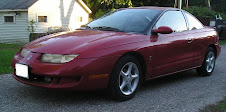
In late February a '98 Saturn SC2 showed up on Craig's List with a blown engine. I went to see it, saw that the body and interior were in pretty good condition, and made an offer. I ended up getting it for $500. Not bad. Unfortunately, the car was sitting in a driveway (not drivable, obviously) 90 miles away from where it needed to be. So, ouch, the tow was more than I want to think about, but I still was under my target of $1,000 for the donor.
I have a garage at my house, but it's a tiny 1-car with a very low ceiling. Not conducive to massive auto transformations. Lucky for me a good friend of mine has a large detached garage that is relatively unused. Even luckier is that she has a large, rolling toolbox full of goodies (she's done a considerable bit of car work herself), including an engine hoist and air tools. And, luckiest, I have another good friend who has lots of experience with this kind of work, and willing to help me out.
Cold weather and my busy schedule has limited my progress with getting the combustion components out, but I've been making steady progress.
Progress:
Here's the car just after being pushed into the garage. The garage looked big before the car went in, but there's not much space left now! Better re-arrange things in there before going too far.


The paint looks pretty good, though I'm not big on the color. A visit to Maaco may be in this car's future.


The interior is in pretty good shape. Bit of wear on the clutch pedal, though. We'll have to see about the condition of the clutch.


Looks like the engine has had its share of problems in the past. Valve cover gasket has been replaced (new blue gasket) and oil has been slung all over the pulley end of the engine compartment. These pictures don't do the mess justice. I wish the car ran well enough to get it to a carwash so I could steam clean the oil off before starting the disassembly.
Once I lifted the car and started peeking around underneath I realized that the oil mess wasn't confined to the pulley end. Bell housing and tranny are also drenched in oil. What a mess!

Now the fun begins! It's amazing to me how much stuff automakers cram into the front end of their cars, and how much stuff is needed to make a combustion engine work. Every time I pull something out, it reveals 3 more things to disconnect. I'm trying to label things as they come out - since this is my first attempt, I'm not 100% sure what I will or won't need once I start installing electric components. But after many hours of preparation work, the day finally came....


Finally, an empty engine compartment!

And a lonely pile of metal and oil.

Good news, though. Looks like the clutch has been replaced recently, so I won't have to pony up for new parts there. I do have my work cut out for me, though, in cleaning up the tranny before reinstalling.


It's starting to feel real now.
In late February a '98 Saturn SC2 showed up on Craig's List with a blown engine. I went to see it, saw that the body and interior were in pretty good condition, and made an offer. I ended up getting it for $500. Not bad. Unfortunately, the car was sitting in a driveway (not drivable, obviously) 90 miles away from where it needed to be. So, ouch, the tow was more than I want to think about, but I still was under my target of $1,000 for the donor.
I have a garage at my house, but it's a tiny 1-car with a very low ceiling. Not conducive to massive auto transformations. Lucky for me a good friend of mine has a large detached garage that is relatively unused. Even luckier is that she has a large, rolling toolbox full of goodies (she's done a considerable bit of car work herself), including an engine hoist and air tools. And, luckiest, I have another good friend who has lots of experience with this kind of work, and willing to help me out.
Cold weather and my busy schedule has limited my progress with getting the combustion components out, but I've been making steady progress.
Progress:
Here's the car just after being pushed into the garage. The garage looked big before the car went in, but there's not much space left now! Better re-arrange things in there before going too far.


The paint looks pretty good, though I'm not big on the color. A visit to Maaco may be in this car's future.


The interior is in pretty good shape. Bit of wear on the clutch pedal, though. We'll have to see about the condition of the clutch.


Looks like the engine has had its share of problems in the past. Valve cover gasket has been replaced (new blue gasket) and oil has been slung all over the pulley end of the engine compartment. These pictures don't do the mess justice. I wish the car ran well enough to get it to a carwash so I could steam clean the oil off before starting the disassembly.
Once I lifted the car and started peeking around underneath I realized that the oil mess wasn't confined to the pulley end. Bell housing and tranny are also drenched in oil. What a mess!

Now the fun begins! It's amazing to me how much stuff automakers cram into the front end of their cars, and how much stuff is needed to make a combustion engine work. Every time I pull something out, it reveals 3 more things to disconnect. I'm trying to label things as they come out - since this is my first attempt, I'm not 100% sure what I will or won't need once I start installing electric components. But after many hours of preparation work, the day finally came....


Finally, an empty engine compartment!

And a lonely pile of metal and oil.

Good news, though. Looks like the clutch has been replaced recently, so I won't have to pony up for new parts there. I do have my work cut out for me, though, in cleaning up the tranny before reinstalling.


It's starting to feel real now.
Tuesday, March 31, 2009
The Concept
So here's what I'm thinking.
Donor vehicle
In the converting world, there seem to be two schools of thought. Either go as light as you can (CRX, 914) or use a small truck (Ranger, S10) and load it up with batteries. Having seating for only 2 is fine with me, but I'm not enamored with the thought of driving a truck to work every day. Plus, why drag along 1800 lbs of Pb just to get me to and from work? I'm already used to driving an econobox ('97 Civic), so my plan is to convert a light, small car.
I'd convert my Civic (not quite as light as a CRX, but close) except that it's a sedan and my assumption is that in converting a small car I'll need to remove the back seat to make room for batteries. It just seems weird to me to have 4 doors and only 2 seats. Anyway, I'll need to commute to work in something while I'm converting, so my current car will not be the donor. It's a shame, too, because I think my Civic is on its last legs.
Donor car requirements:
AC/DC
So, what to put in this donor car? Most conversions use series-wound DC motors. They are simpler, cheaper, and have better low-end torque. However, they are also limited to low voltage, lack regenerative braking, are less efficient, and have limited RPM range. For me, the killer is the low voltage limitation. Low voltage means high current from the batteries, high enough that the only usable batteries are flooded Pb-Acid. By contrast, AC induction motors are more complex and expensive, but can use high-voltage battery packs, provide regenerative braking, are more efficient, have flatter torque curves, and can spin to ludicrous RPMs.
Since I've already decided that the electric components will outlast any donor vehicle (maybe 2 or 3 donors!) my assumption is that whatever system I use would last long enough to where I'd be able to take advantage of low-cost, durable lithium batteries that I believe will be available (eternal optimist that I am). The only way to take advantage of those next-generation batteries is to use AC. At this time, however, the best value in batteries are still flooded Pb-Acid so I'll start my EV life with those.
Will it work?
Requirements for the car:
My plan:
Budget
Hard to believe how much I'm going to be spending. There are cheaper ways to go (even sticking with AC), but I want to maximize my chances of success here so I'll rely on the experts at ElectroAuto and purchase one of their kits. Most likely the AC24 motor, but I may splurge for the extra torque of the AC24LS. So... gulp... $10K for a kit, another $2-3K for batteries, $1K for the donor, and probably another $500 in miscellany. I just have to keep in mind that it's cheaper than buying a new car, or even a late-model used one. And these components should last a lot longer.
So let's find a car!
Donor vehicle
In the converting world, there seem to be two schools of thought. Either go as light as you can (CRX, 914) or use a small truck (Ranger, S10) and load it up with batteries. Having seating for only 2 is fine with me, but I'm not enamored with the thought of driving a truck to work every day. Plus, why drag along 1800 lbs of Pb just to get me to and from work? I'm already used to driving an econobox ('97 Civic), so my plan is to convert a light, small car.
I'd convert my Civic (not quite as light as a CRX, but close) except that it's a sedan and my assumption is that in converting a small car I'll need to remove the back seat to make room for batteries. It just seems weird to me to have 4 doors and only 2 seats. Anyway, I'll need to commute to work in something while I'm converting, so my current car will not be the donor. It's a shame, too, because I think my Civic is on its last legs.
Donor car requirements:
- Coupe or hatchback.
- Readily available and cheap parts. (so, no CRX or 914)
- Air bags. (at least for the driver)
- Body in excellent shape, minimal chassis rust.
- ABS. (nice to have)
- Curb weight under 2,500 lbs.
- Under $1,000 price.
AC/DC
So, what to put in this donor car? Most conversions use series-wound DC motors. They are simpler, cheaper, and have better low-end torque. However, they are also limited to low voltage, lack regenerative braking, are less efficient, and have limited RPM range. For me, the killer is the low voltage limitation. Low voltage means high current from the batteries, high enough that the only usable batteries are flooded Pb-Acid. By contrast, AC induction motors are more complex and expensive, but can use high-voltage battery packs, provide regenerative braking, are more efficient, have flatter torque curves, and can spin to ludicrous RPMs.
Since I've already decided that the electric components will outlast any donor vehicle (maybe 2 or 3 donors!) my assumption is that whatever system I use would last long enough to where I'd be able to take advantage of low-cost, durable lithium batteries that I believe will be available (eternal optimist that I am). The only way to take advantage of those next-generation batteries is to use AC. At this time, however, the best value in batteries are still flooded Pb-Acid so I'll start my EV life with those.
Will it work?
Requirements for the car:
- Capable of highway speeds (though highway speeds kill the range)
- Acceleration which is not embarassing (to a guy who drives a Civic)
- Sufficient range to get me to work (15 miles @40 mph with less than 20% DOD
- Cabin heat (New England weather)
My plan:
- 156 V battery pack (12V flooded Pb-Acid batteries)
- AC24 or AC24LS AC induction motor with DMOC445 controller
- 220V on-board charger
- Electric water heater for cabin heat
- Power brakes (electric vacuum pump)
- Manual steering, no A/C
Budget
Hard to believe how much I'm going to be spending. There are cheaper ways to go (even sticking with AC), but I want to maximize my chances of success here so I'll rely on the experts at ElectroAuto and purchase one of their kits. Most likely the AC24 motor, but I may splurge for the extra torque of the AC24LS. So... gulp... $10K for a kit, another $2-3K for batteries, $1K for the donor, and probably another $500 in miscellany. I just have to keep in mind that it's cheaper than buying a new car, or even a late-model used one. And these components should last a lot longer.
So let's find a car!
Subscribe to:
Posts (Atom)