I haven't updated this in a while, I guess. Again. Been busy. Again. I had to take a few weeks off from working on the car for my daughter's high school graduation, my son's confirmation, and getting the house ready for the inevitable blow-out party. Then, I've had a series of setbacks trying to install components in the engine compartment. But I may have made some progress this weekend, and I have a little time to write an update.
Vacuum System for Power Brakes:
My plan was to put the vacuum reservoir behind and under the DMOC, and above the drive axle. Like this (see the black pipe bomb {kidding!} next to the motor?).
However, I forgot that the DMOC is mounted on rubber bushings and my original bracket for the reservoir interfered with that. So I had to extend the bracket a bit so the reservoir hangs a little lower. It still clears the driveaxle but I'm not sure about the steering. We'll see. Here's a picture of the reservoir with the little extenders on the pipe clamps.
As for the vacuum pump, I came up with a kind of wacky place to put it. I hope I don't pay for this later. As far as I could research the pump will work in any orientation, so I put it upright next to the brake booster. Here's the pump installed (boy, it sure is hard to see black on black, isn't it?).
Water Heater for Cabin Climate Control:
Just above the vacuum system is the water heater. There's not much space around the heater core fittings, so I had to be a little creative with heater hose. I bought a couple of molded hoses with hard 90 degree bends and cut them to make the tough initial bend coming out of the heater core. Once those bends were made, it was pretty easy to plumb into the heater, changing the return line from 5/8" to 3/4".
Heater core fittings:
Hoses running from heater to heater core:
Next, can it be that I'm finally ready to install the main battery boxes???
Monday, June 14, 2010
Wednesday, May 19, 2010
Passenger Door Window
In my last post, I showed that the rear sash bushing in the window regulator was missing. I had thought about machining a replacement bushing in Delrin, but in the end decided it wasn't worth it. Instead of spending hours machining something that may or may not work I decided to just get a new regulator. I am anxious to get this car on the road and spending time on non-EV-related activities just doesn't seem worth it to me. So I found junkie regulators for $50 (plus shipping, because none of the boneyards near me have Saturn coupes), or brand-spanking-new regulators from RockAuto.com for $80 plus or minus. No brainer for me - a few clicks of the mouse and 2 days later a brand-new regulator shows up at my door. Nice!
I don't have any pictures of the intermediate steps, but suffice it to say that the new regulator went in pretty easily. However, when I tried to put the glass back in it didn't seem to want to go in straight. And once I was able to wiggle it into what I thought was the right spot it seemed jammed. Thinking that there might be some debris in the window track, I started feeling around inside and discovered that the rubber guide at the front window track was twisted which prevented the window from sliding properly. Aha! So that's why the bushing broke in the first place!
Well, I couldn't access that rubber piece from the inside of the door so I had to take the outer (plastic) panel off to access it. It actually was fairly easy to do - remove 3 nuts and the side-view mirror comes off, pry out the outer window trim, undo 10 torx bolts, and voila! the panel falls off. Once the outer panel was off it was easy to readjust the rubber guide - here are a couple of pics of it already fixed (forgot to take a picture of its original state!).
With the exterior panel off, installing the window was a breeze. I checked the operation of the window a few times (works beautifully) and then reassembled the door. Of course I forgot to install one of the styrofoam pieces (doh!), so I had to take it apart and put it together again, but it's amazing how easy it is to do something for the second time.
A couple of pics of the newly assembled and perfectly operating door. Success!
Yah, I know. The car is filthy. All in good time.........
Now, if only the EV parts of the car can go together as easily.
I don't have any pictures of the intermediate steps, but suffice it to say that the new regulator went in pretty easily. However, when I tried to put the glass back in it didn't seem to want to go in straight. And once I was able to wiggle it into what I thought was the right spot it seemed jammed. Thinking that there might be some debris in the window track, I started feeling around inside and discovered that the rubber guide at the front window track was twisted which prevented the window from sliding properly. Aha! So that's why the bushing broke in the first place!
Well, I couldn't access that rubber piece from the inside of the door so I had to take the outer (plastic) panel off to access it. It actually was fairly easy to do - remove 3 nuts and the side-view mirror comes off, pry out the outer window trim, undo 10 torx bolts, and voila! the panel falls off. Once the outer panel was off it was easy to readjust the rubber guide - here are a couple of pics of it already fixed (forgot to take a picture of its original state!).
With the exterior panel off, installing the window was a breeze. I checked the operation of the window a few times (works beautifully) and then reassembled the door. Of course I forgot to install one of the styrofoam pieces (doh!), so I had to take it apart and put it together again, but it's amazing how easy it is to do something for the second time.
A couple of pics of the newly assembled and perfectly operating door. Success!
Yah, I know. The car is filthy. All in good time.........
Now, if only the EV parts of the car can go together as easily.
Wednesday, May 12, 2010
Radiator Battery Box and Passenger Door Window
Between throwing out my back and having a house full of relatives not much has been happening, but I made some small progress this week.
Radiator Battery Box
I previously showed the car modifications needed in order to put two batteries where the radiator used to reside. Since then I've:
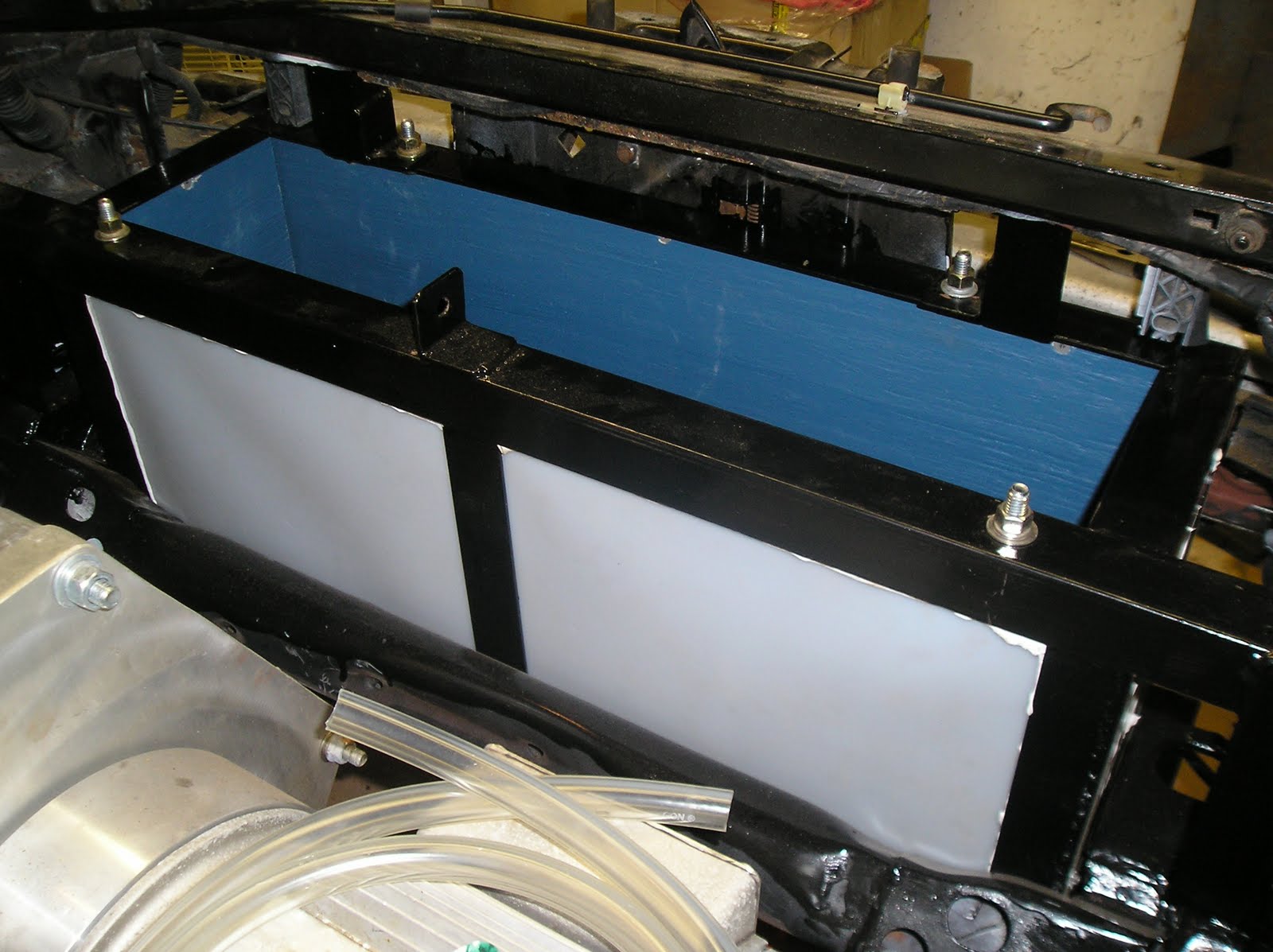
Here are a couple of views of the box installed:
Looking into the engine compartment toward the front of the car.
Close-up of the front corner of the box, looking through the space where the headlights will reside.
View from the front of the car. It's really hard to see, but the sway bar is lower than the bottom of the box, so it shouldn't interfere with the operation of the car (or the belly pan I'd like to install).
Passenger Door
When I bought the car the passenger door window mechanism was broken. When I took the door apart to investigate I saw that one of the bushings that connects the scissor mechanism to the window sash was missing. Here is a picture of the sash and scissor mechanism showing where the part is missing.
There are two of these bushings. Here's a picture of the front bushing.
You can't purchase those bushings individually, unfortunately, only as part of the entire regulator (sash, scissor mechanism, motor), so I'm going to try and machine a new bushing out of delrin. If that fails, then I'll get a junkyard regulator to replace the entire thing.
Radiator Battery Box
I previously showed the car modifications needed in order to put two batteries where the radiator used to reside. Since then I've:
- Painted the frames
- Cut pieces of wood which will be the bottom and sides of the box
- Painted the wood with (blue) epoxy paint
- Cut pieces of plastic (HDPE, 0.020" thick) to put in between the wood and frame (prevents water which might come in through the grille from soaking into the wood)
- Attached the wood and plastic (with caulking to seal between plastic and frame) to the frame with self-tapping screws
- Cut off the excess screw length
Here are a couple of views of the box installed:
Looking into the engine compartment toward the front of the car.
Close-up of the front corner of the box, looking through the space where the headlights will reside.
View from the front of the car. It's really hard to see, but the sway bar is lower than the bottom of the box, so it shouldn't interfere with the operation of the car (or the belly pan I'd like to install).
Passenger Door
When I bought the car the passenger door window mechanism was broken. When I took the door apart to investigate I saw that one of the bushings that connects the scissor mechanism to the window sash was missing. Here is a picture of the sash and scissor mechanism showing where the part is missing.
There are two of these bushings. Here's a picture of the front bushing.
You can't purchase those bushings individually, unfortunately, only as part of the entire regulator (sash, scissor mechanism, motor), so I'm going to try and machine a new bushing out of delrin. If that fails, then I'll get a junkyard regulator to replace the entire thing.
Tuesday, May 4, 2010
Battery Boxes (again)
In previous posts, I showed the design and fabrication of the metal and wood portions of the battery boxes. My original intent was to have the lids push down on the batteries with small lengths of PVC pipe. I've seen this done on several conversions on the web. The main advantage of this method for me is that it simplifies the bottom of the box, especially how easy it will be to contain any spills. However, it greatly complicated the design and strength requirements for the lid. My original plan called for an angle iron frame and support members that would be very heavy and would require large bolts to hold it in place. These large bolts and heavy lid would have to be removed every time I wanted to check water levels or electrical connections. In addition, because of the placement of the battery boxes in the back of the car, it would be very awkward to reach some of the bolts. Finally, it was not clear to me that the lids could be removed with the seats in place. Too much effort!
So, instead, I opted for a different design. This one is also described by many converters on the web. Instead of pushing down on the batteries from the lid, I will use threaded rods with steel pieces laid across the tops of the batteries to pull them down from the base of the box, just like the starter battery in all ICE cars. I opted for 5/16" threaded rod and 1" steel box tubing in place of the usual M4(?) threaded rod and polypropylene battery straps or molded pieces that are used for starter batteries.
Since there is little space underneath the battery boxes (I'm trying to keep the batteries as low as possible without cutting into the floor) I welded nuts to the top side of the bottom frame.

The steel tubing was a little challenging. For the main box (6 batteries side by side) there was plenty of room for the tubing to run down the center of the batteries. There is a nice gap in the row of filler caps, and plenty far away from all of the battery terminals.
However, because the box was designed to just barely fit the width of the back seat area, the top frame angle pieces point "in." This means that the threaded rod will be directly under a piece of steel, and so the tubing cannot be dropped straight down on it. So I cut slots in the tubing so that it can be slid onto the threaded rod from the side.
Also, because the tubing will have to span 6 batteries I wanted to add a threaded rod to the center of the box to limit the span. So, I made a "T" out of a couple pieces of flat bar and welded a nut to that for the center threaded rod. This meant that I had to cut the bottom wood piece in half (so now it's much easier to load into the box!) to make room for the new "T."
Since there are three tie-down places for this piece of tubing, I put the two slots on opposite sides. So, when installing the tubing I drop the tubing over the center threaded rod with the tubing pointing to the corners of the battery box, then rotate the tubing until the ends meet the two threaded rods at the ends of the battery box.
Here's a picture showing the end of the steel tubing. It's hard to tell from this angle, but there isn't a lot of space between the top of the threaded rod and the steel angle.
For the rearmost battery box the steel tubing was challenging in another way. In this case the top frame is angled "outboard" so there will be no issues with dropping the tubing straight down onto the threaded rod. However, in this box the batteries are laid end-to-end, and what I quickly discovered is that there is not room for the steel tubing between the battery terminals and the filler caps. Instead of opting for a smaller version of tubing (1/2" would probably work ok) for each row (there are 2), I chose to hold the batteries down by their edges instead. My plan is to have a single piece of tubing run along the common edge between the two rows of batteries, with "outriggers" welded in place to help keep the batteries from jostling out of place. Kind of looks like a TV antenna?
This welded tube structure will be held down in two locations, inboard from the very end of the box, so the span is not excessive. In these locations, there's a nice strong piece of angle to weld the nuts to.
In both cases, the batteries will be constrained at the bottom so they cannot slide around. No pictures yet, but I plan to use pieces of wood screwed into the bottom.
The radiator box added another challenge to the hold-down scheme. The batteries are also laid end-to-end in this box, so the 1" tubing will not fit. So I bought some 3/4" aluminum tubing to lay across the batteries. However, this box is not as tall as the rear battery boxes (by mistake? Possibly.) so I've opted in this case to use my original intent of pushing the batteries down. These batteries will be loaded from the bottom so I will lay pieces of 1" tubing across the battery (side-to-side) which will contact the top frame when they are in place. I may have to add a piece of silicone rubber under these pieces of tubing so that the batteries are held snugly when the base is fully installed. A junk piece of steel tubing (welding practice!) illustrates the concept.
So, after slapping some paint on the newly-welded parts of these boxes I should finally be able to load them into the car!
So, instead, I opted for a different design. This one is also described by many converters on the web. Instead of pushing down on the batteries from the lid, I will use threaded rods with steel pieces laid across the tops of the batteries to pull them down from the base of the box, just like the starter battery in all ICE cars. I opted for 5/16" threaded rod and 1" steel box tubing in place of the usual M4(?) threaded rod and polypropylene battery straps or molded pieces that are used for starter batteries.
Since there is little space underneath the battery boxes (I'm trying to keep the batteries as low as possible without cutting into the floor) I welded nuts to the top side of the bottom frame.
The steel tubing was a little challenging. For the main box (6 batteries side by side) there was plenty of room for the tubing to run down the center of the batteries. There is a nice gap in the row of filler caps, and plenty far away from all of the battery terminals.
However, because the box was designed to just barely fit the width of the back seat area, the top frame angle pieces point "in." This means that the threaded rod will be directly under a piece of steel, and so the tubing cannot be dropped straight down on it. So I cut slots in the tubing so that it can be slid onto the threaded rod from the side.
Also, because the tubing will have to span 6 batteries I wanted to add a threaded rod to the center of the box to limit the span. So, I made a "T" out of a couple pieces of flat bar and welded a nut to that for the center threaded rod. This meant that I had to cut the bottom wood piece in half (so now it's much easier to load into the box!) to make room for the new "T."
Since there are three tie-down places for this piece of tubing, I put the two slots on opposite sides. So, when installing the tubing I drop the tubing over the center threaded rod with the tubing pointing to the corners of the battery box, then rotate the tubing until the ends meet the two threaded rods at the ends of the battery box.
Here's a picture showing the end of the steel tubing. It's hard to tell from this angle, but there isn't a lot of space between the top of the threaded rod and the steel angle.
For the rearmost battery box the steel tubing was challenging in another way. In this case the top frame is angled "outboard" so there will be no issues with dropping the tubing straight down onto the threaded rod. However, in this box the batteries are laid end-to-end, and what I quickly discovered is that there is not room for the steel tubing between the battery terminals and the filler caps. Instead of opting for a smaller version of tubing (1/2" would probably work ok) for each row (there are 2), I chose to hold the batteries down by their edges instead. My plan is to have a single piece of tubing run along the common edge between the two rows of batteries, with "outriggers" welded in place to help keep the batteries from jostling out of place. Kind of looks like a TV antenna?
This welded tube structure will be held down in two locations, inboard from the very end of the box, so the span is not excessive. In these locations, there's a nice strong piece of angle to weld the nuts to.
In both cases, the batteries will be constrained at the bottom so they cannot slide around. No pictures yet, but I plan to use pieces of wood screwed into the bottom.
The radiator box added another challenge to the hold-down scheme. The batteries are also laid end-to-end in this box, so the 1" tubing will not fit. So I bought some 3/4" aluminum tubing to lay across the batteries. However, this box is not as tall as the rear battery boxes (by mistake? Possibly.) so I've opted in this case to use my original intent of pushing the batteries down. These batteries will be loaded from the bottom so I will lay pieces of 1" tubing across the battery (side-to-side) which will contact the top frame when they are in place. I may have to add a piece of silicone rubber under these pieces of tubing so that the batteries are held snugly when the base is fully installed. A junk piece of steel tubing (welding practice!) illustrates the concept.
So, after slapping some paint on the newly-welded parts of these boxes I should finally be able to load them into the car!
Friday, April 30, 2010
Engine Compartment Trays
In previous posts I described mounting the motor-transmission assembly and the battery box located where the radiator used to be. Now for the rest of the components. It's a bit of a Tetris puzzle, but the other components that I want to place in the engine compartment include:
Of course, none of them were really designed with the Saturn engine compartment in mind, nor were they designed to nest together well. After hours of head-scratching and experimentation with various placements, we came up with a plan that gets everything placed reasonably well with the exception of the Zivan unit. So it looks like the Zivan will be relegated to the trunk after all. Here's the layout schematically.
The components are mounted to 2 trays that are affixed to various frame members in the engine compartment. It was manufactured in 2 pieces so that they could be easily loaded/unloaded. The main tray will be attached to the passenger side frame (near where the original upper engine mount was located), to the subframe in the center-rear of the engine compartment (just behind the steering rack), and to the angle iron welded in place to support the radiator battery box. This tray will hold the DMOC controller, RM4 fluid heater, the vacuum system reservoir, and the 12V electrical box. A second tray bolts to the main tray in 2 locations (front and rear of the engine compartment) and to the driver side frame (near the transmission torque rod mount). This tray will hold the DC-DC converter, vacuum pump, a U1 accessory battery (wheelchair battery), and the high-voltage electrical box. It was possible to rearrange the components so that a standard Saturn starter battery would fit, but why carry the extra weight when I won't need to start anything?!? The U1 size should be plenty big to act as a capacitor between the DC-DC converter and the various 12V loads in the car.
Here's the main tray installed.
This is a close-up of the rear extension, showing the tray attached to the subframe behind the steering rack.
Here's a close-up of the attachment to the radiator battery box rear support.
Here's a view of the second tray installed. Notice that the bell housing sticks up above the tray, complicating placement of some of the components. This tray is bolted to the main tray on the left and screwed (self-tapping screws) into the main car frame member on the right.
I don't have a good photo showing the trays installed with components in place. I'll update with good photos once everything is mounted in place.
Most of the components are simply bolted through the angle iron bottom of the two trays, often with rubber mounts, but the fluid heater and vacuum pump were extra challenging.
The fluid heater doesn't have any straight edges. It looks a bit like two tapered cups joined together at their rims. There is a flange which runs along the axis of the heater with 2 holes drilled into it that is meant to be used to mount the unit. This flange does not look beefy enough to me, and I was worried that it would not hold its own weight considering the vibrations and g-forces of a driving car, so I opted to use a "riser" pipe clamp (McMaster-Carr PN3065T54) around the lower tapered surface. The riser clamp bolts were welded to two pieces of angle welded vertically to the bottom of the tray. By the way, McMaster-Carr has without a doubt THE best website in the world. I am continually amazed at how easily I can search for items, and how easy it is to order things. Plus they've delivered to me the next day every time, without fail. They rock!
Anyway, here's a picture of the fluid heater with the rise clamp. You can barely see the "mounting flange" on the left side of the unit.
The idea is to bolt the riser clamp to little uprights welded into the main tray in the back left corner (looking at it from in front of the car). In order to keep it from hitting the hood, the bottom of the heater will actually descend below the tray by a few inches. It fits nicely just behind the motor casing but still above the drive shaft. It might be hard to see here (kinda dark - I need some photography lessons), but this picture shows the heater installed in the tray. You can see one of the angle iron pieces to which the riser clamp is bolted.
The vacuum pump also presented some challenges. Not because it is difficult to mount, but it's just awfully big, and I wanted to keep it close to the brake booster. I ended up actually mounting it vertically, next to the brake booster and master cylinder, with the business end up. I'm not totally enamored of the location, but hopefully it will work ok for now. I think it will clear the hood, but I haven't tried it yet. My eyeball says it's going to be close. I don't have a great picture of this yet, but I'll take lots of pictures once all the components are installed. The vacuum reservoir is going to hang down from the main tray to the right of the fluid heater between the motor casting and the firewall. There's room there, and I plan to just use 4" pipe clamps attached to the back of the tray.
Here's a picture of the DC-DC converter and accessory battery approximately in place. This also shows the approximate location of the high-voltage electrical box. Again, the lighting leaves a lot to be desired.
Next step: drill mounting holes in the trays, paint them up, and install them.
- DMOC445 motor controller
- RM4 fluid heater with pump
- DC-DC converter
- Zivan NG3 battery charger
- Vacuum pump and reservoir (for power brakes)
- Accessory battery (standard 12V starter battery, or a smaller version?)
- 2 electrical boxes for relays, shunts, connectors, etc.
Of course, none of them were really designed with the Saturn engine compartment in mind, nor were they designed to nest together well. After hours of head-scratching and experimentation with various placements, we came up with a plan that gets everything placed reasonably well with the exception of the Zivan unit. So it looks like the Zivan will be relegated to the trunk after all. Here's the layout schematically.
The components are mounted to 2 trays that are affixed to various frame members in the engine compartment. It was manufactured in 2 pieces so that they could be easily loaded/unloaded. The main tray will be attached to the passenger side frame (near where the original upper engine mount was located), to the subframe in the center-rear of the engine compartment (just behind the steering rack), and to the angle iron welded in place to support the radiator battery box. This tray will hold the DMOC controller, RM4 fluid heater, the vacuum system reservoir, and the 12V electrical box. A second tray bolts to the main tray in 2 locations (front and rear of the engine compartment) and to the driver side frame (near the transmission torque rod mount). This tray will hold the DC-DC converter, vacuum pump, a U1 accessory battery (wheelchair battery), and the high-voltage electrical box. It was possible to rearrange the components so that a standard Saturn starter battery would fit, but why carry the extra weight when I won't need to start anything?!? The U1 size should be plenty big to act as a capacitor between the DC-DC converter and the various 12V loads in the car.
Here's the main tray installed.
This is a close-up of the rear extension, showing the tray attached to the subframe behind the steering rack.
Here's a close-up of the attachment to the radiator battery box rear support.
Here's a view of the second tray installed. Notice that the bell housing sticks up above the tray, complicating placement of some of the components. This tray is bolted to the main tray on the left and screwed (self-tapping screws) into the main car frame member on the right.
I don't have a good photo showing the trays installed with components in place. I'll update with good photos once everything is mounted in place.
Most of the components are simply bolted through the angle iron bottom of the two trays, often with rubber mounts, but the fluid heater and vacuum pump were extra challenging.
The fluid heater doesn't have any straight edges. It looks a bit like two tapered cups joined together at their rims. There is a flange which runs along the axis of the heater with 2 holes drilled into it that is meant to be used to mount the unit. This flange does not look beefy enough to me, and I was worried that it would not hold its own weight considering the vibrations and g-forces of a driving car, so I opted to use a "riser" pipe clamp (McMaster-Carr PN3065T54) around the lower tapered surface. The riser clamp bolts were welded to two pieces of angle welded vertically to the bottom of the tray. By the way, McMaster-Carr has without a doubt THE best website in the world. I am continually amazed at how easily I can search for items, and how easy it is to order things. Plus they've delivered to me the next day every time, without fail. They rock!
Anyway, here's a picture of the fluid heater with the rise clamp. You can barely see the "mounting flange" on the left side of the unit.
The idea is to bolt the riser clamp to little uprights welded into the main tray in the back left corner (looking at it from in front of the car). In order to keep it from hitting the hood, the bottom of the heater will actually descend below the tray by a few inches. It fits nicely just behind the motor casing but still above the drive shaft. It might be hard to see here (kinda dark - I need some photography lessons), but this picture shows the heater installed in the tray. You can see one of the angle iron pieces to which the riser clamp is bolted.
The vacuum pump also presented some challenges. Not because it is difficult to mount, but it's just awfully big, and I wanted to keep it close to the brake booster. I ended up actually mounting it vertically, next to the brake booster and master cylinder, with the business end up. I'm not totally enamored of the location, but hopefully it will work ok for now. I think it will clear the hood, but I haven't tried it yet. My eyeball says it's going to be close. I don't have a great picture of this yet, but I'll take lots of pictures once all the components are installed. The vacuum reservoir is going to hang down from the main tray to the right of the fluid heater between the motor casting and the firewall. There's room there, and I plan to just use 4" pipe clamps attached to the back of the tray.
Here's a picture of the DC-DC converter and accessory battery approximately in place. This also shows the approximate location of the high-voltage electrical box. Again, the lighting leaves a lot to be desired.
Next step: drill mounting holes in the trays, paint them up, and install them.
Wednesday, April 28, 2010
Rear End Upgrade
Upgraded rear suspension
Back in November of last year I wrote about the proposed battery locations and extra load expected on the rear axle. Once I finalized those proposed locations, I ordered new springs from Springworks to accommodate the extra weight. Over the winter I swapped them out. No use putting old struts inside the new springs, so I changed them as well, even though I had no idea if they had been replaced before. The changeover was a breeze - I was able to use a real (wall-mount) strut compressor at a friend's shop.
Here's a picture of the old strut assemblies with one of the new springs. Notice the new spring is variable rate. I'm not sure if it will make a difference in the ride or not, but my recollection is that it wasn't any more expensive.
Here's a picture of the new strut assemblies. The strut mounts actually looked ok, so I didn't end up replacing them.
Since I had the rear suspension off, I also replaced the broken sway bar link on the driver side. Here are pictures of the broken link and replaced links.

The car hasn't been on the ground yet since the swap-over. It'll be interesting to see how level the car sits once the batteries are installed.
Back in November of last year I wrote about the proposed battery locations and extra load expected on the rear axle. Once I finalized those proposed locations, I ordered new springs from Springworks to accommodate the extra weight. Over the winter I swapped them out. No use putting old struts inside the new springs, so I changed them as well, even though I had no idea if they had been replaced before. The changeover was a breeze - I was able to use a real (wall-mount) strut compressor at a friend's shop.
Here's a picture of the old strut assemblies with one of the new springs. Notice the new spring is variable rate. I'm not sure if it will make a difference in the ride or not, but my recollection is that it wasn't any more expensive.
Here's a picture of the new strut assemblies. The strut mounts actually looked ok, so I didn't end up replacing them.
Since I had the rear suspension off, I also replaced the broken sway bar link on the driver side. Here are pictures of the broken link and replaced links.
The car hasn't been on the ground yet since the swap-over. It'll be interesting to see how level the car sits once the batteries are installed.
Tuesday, April 27, 2010
Checking back in...
Will this car ever be done? I'm beginning to wonder. I'm even wondering if it will ever be on wheels again! It's been on blocks so long that I'll bet the frame is permanently sagged. Certainly the doors don't open and shut like they used to. Oh well, I'll worry about that when I'm getting ready to roll it out into the elements. Also, clearly I'm not cut out to be a blogger. It's been nearly 3 months since my last entry! And there wasn't much there either.
So, here's what's happened in the past 3 months:
Battery boxes
Engine compartment
General
Ok, so here's where the rubber meets the road. I am going to try and be more diligent (have I said this before? Probably, but I don't want to look back and check. Too embarrassed!), so firstly I'll write a few retrospective entries to explain what's happened over the past 3 months then see where I go from there. I've also got to do better with taking pictures. The problem with working alone a lot is that I don't ever think about documenting what I'm doing, so I'm not sure how good these retrospectives are going to be....
Plunging back into the blogosphere I go.
So, here's what's happened in the past 3 months:
Battery boxes
- Cut and painted all the plywood that will be the "box" part of the battery boxes. I previously showed the angle framework for these boxes.
- Discarded my original "battery hold down system," designed and installed a new one that I like a lot better.
- The new battery hold down system meant redesigning the lids. That is done as well, though the lids have not yet been painted.
Engine compartment
- Fabricated trays to hold engine components, including DMOC, DC/DC converter, fluid heater, vacuum system, and accessory battery.
General
- Fabricated and installed PVC pipe through center "hump" to run battery cables from rear battery box to engine compartment.
- Fabricated brackets in trunk for the Zivan charger.
- Replaced rear struts - new struts and new heavier springs (for additional 800 lbs on rear axle).
- Replaced front and rear brakes (rotors, pads)
- Re-wired the garage where the car is stored.
Ok, so here's where the rubber meets the road. I am going to try and be more diligent (have I said this before? Probably, but I don't want to look back and check. Too embarrassed!), so firstly I'll write a few retrospective entries to explain what's happened over the past 3 months then see where I go from there. I've also got to do better with taking pictures. The problem with working alone a lot is that I don't ever think about documenting what I'm doing, so I'm not sure how good these retrospectives are going to be....
Plunging back into the blogosphere I go.
Subscribe to:
Posts (Atom)